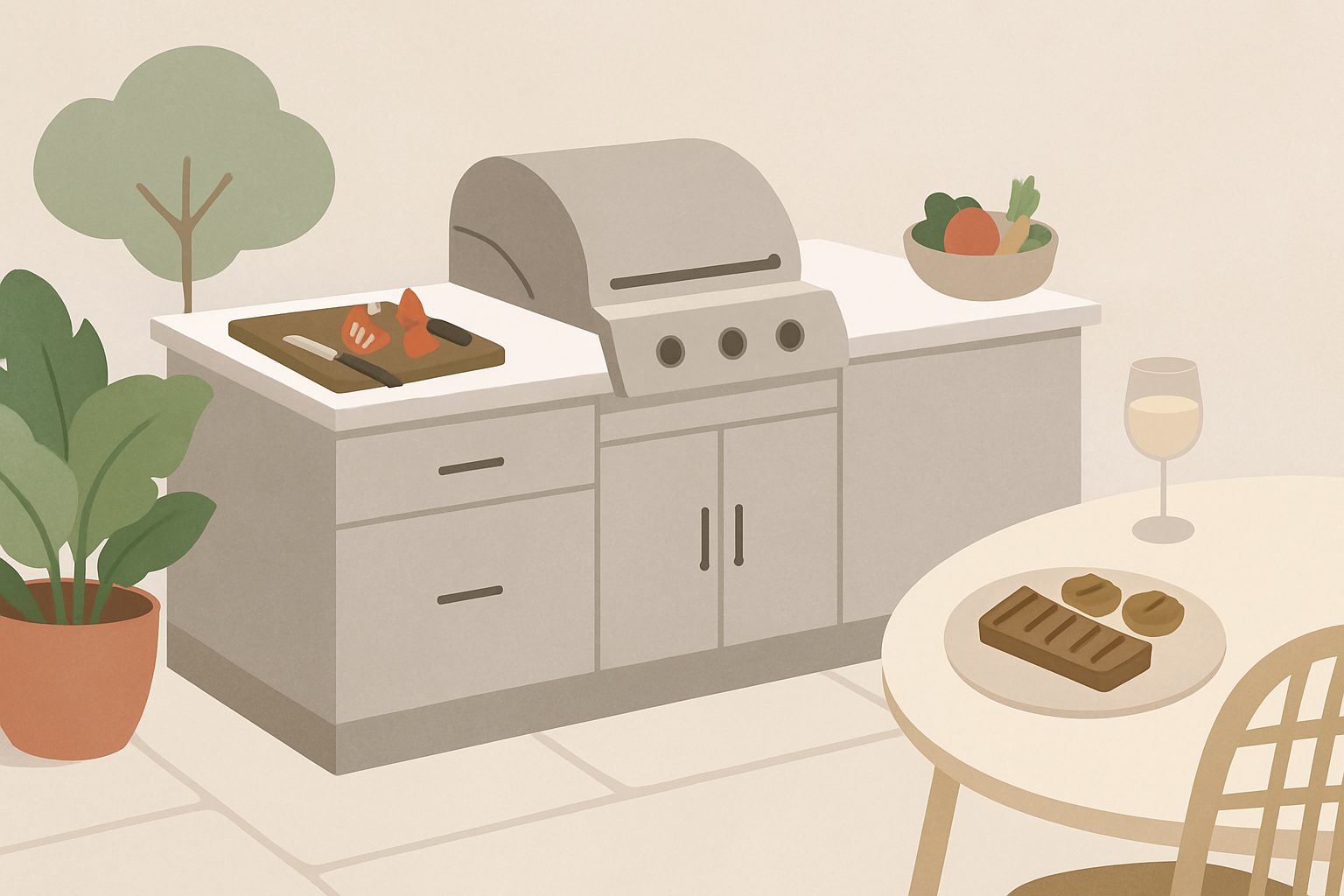
Outdoor Kitchen Islands on Patios vs Decking in the UK – What You Need to Know
Installing an outdoor kitchen island transforms how you use garden space. But before you commit to a location, you need to understand how your chosen surface—patio or decking—will affect the island's performance, durability, and safety. This isn't just about aesthetics; it's about engineering.
Weight Load Capacity: The Critical Difference
Outdoor kitchen islands are heavy. A modest stainless steel island with a built-in grill, work surface, and storage can easily weigh 200–400 kg. Add brick or stone cladding, and you're looking at 500 kg or more.
Concrete patios can handle this comfortably. A standard 150 mm patio slab laid on a prepared base typically bears point loads of 3–4 kN/m² without issue—more than enough for a kitchen island. The weight distributes directly onto solid ground.
Decking is different. Most residential decking is built on joists spaced 400–600 mm apart, designed to support around 5 kN/m² of distributed load—roughly the weight of people standing on it. A heavy island concentrates its weight onto a small footprint, creating a point load that can exceed what decking joists tolerate. Over time, you risk sagging, cracking the boards, or straining the frame.
This doesn't mean decking won't work. It means you need either a reinforced deck built specifically to handle the load, or a lightweight island designed for timber surfaces. Some manufacturers now produce modular islands with aluminium frames and composite panels—typically under 150 kg—which sit safely on standard decking.
Drainage: Water Finds Its Way
British weather means water management is non-negotiable.
Patios shed water naturally. If your patio slopes even slightly (a 1:60 fall is standard practice), water runs off or pools away from the island base. Minor splashes during food prep drain away without accumulating. The risk of water damage to the island's structure and surrounding patio is minimal, provided your patio was built with proper drainage underneath.
Decking changes the equation. Water doesn't evaporate quickly from beneath a timber deck, especially in damp UK autumns and winters. Standing water accelerates rot in joists and encourages mould. An outdoor kitchen island creates a static object that disrupts water flow across the deck surface. Water pools around its base, seeping between boards and into the sub-structure.
You can mitigate this with proper decking design—spacing boards to allow water through, installing a permeable membrane beneath the island, or building a slight slope into the deck. But it requires more thought and careful installation. A poorly drained deck with an island becomes a rot risk within three to five years.
Fixing and Stability: Securing the Island
How you anchor your island matters for safety and longevity.
On a patio, an island sits directly on the slab. Depending on weight and wind exposure, you may need no fixing at all—gravity keeps it stable. For heavier units or exposed gardens, you can bolt directly into the concrete using expansion bolts. The connection is simple and permanent. There's no movement, no flexing, and no risk of gradual loosening over time.
On decking, bolting isn't straightforward. You can't drill into joists without weakening them significantly. Instead, islands are typically fixed using joist hangers or heavy-duty timber brackets bolted to the deck frame. This works, but every connection point is a potential weak link, especially where wood absorbs moisture and expands or contracts seasonally. Fixings can loosen; wood can rot around anchor points. Regular inspection and maintenance become essential.
Maintenance and Longevity
A patio-based island usually outlasts a deck-based one.
Concrete is inert—it doesn't rot, swell, or shrink. An island sitting on a well-maintained patio can operate without structural issues for 15–20 years or more. The island itself (its cladding, appliances, and finishes) will age, but the foundation stays sound.
Timber decking is organic. Even pressure-treated joists have a 15–25-year lifespan, depending on maintenance and climate. An island accelerates that degradation locally because it traps moisture. If you're planning to keep the island for 10+ years, you're increasingly betting on good luck with the decking underneath.
The Practical Takeaway
For a patio, you can confidently choose any island design. Heavy, permanent structures work without compromise.
For decking, you have two sensible paths: invest in reinforced decking designed for point loads—more expensive upfront, but future-proof—or opt for lightweight, modular islands specifically engineered for timber surfaces. These weigh under 150 kg, distribute load more forgivingly, and can be repositioned if needed.
Budget for drainage management on decking too. A slight sub-deck slope, proper board spacing, and a permeable foundation membrane add cost but pay dividends in deck longevity.
The honest answer: patios are the simpler, lower-maintenance choice. Decking can work, but requires better planning and design to avoid costly repairs later.
More options
- Modular Outdoor Kitchen Island Units (Amazon UK)
- Stainless Steel Outdoor Kitchen BBQ Island (Amazon UK)
- Outdoor Kitchen Island Weatherproof Cover (Amazon UK)
- Outdoor Rated Undercounter Fridge (Amazon UK)
- Outdoor Pizza Oven Insert for Kitchen Island (Amazon UK)